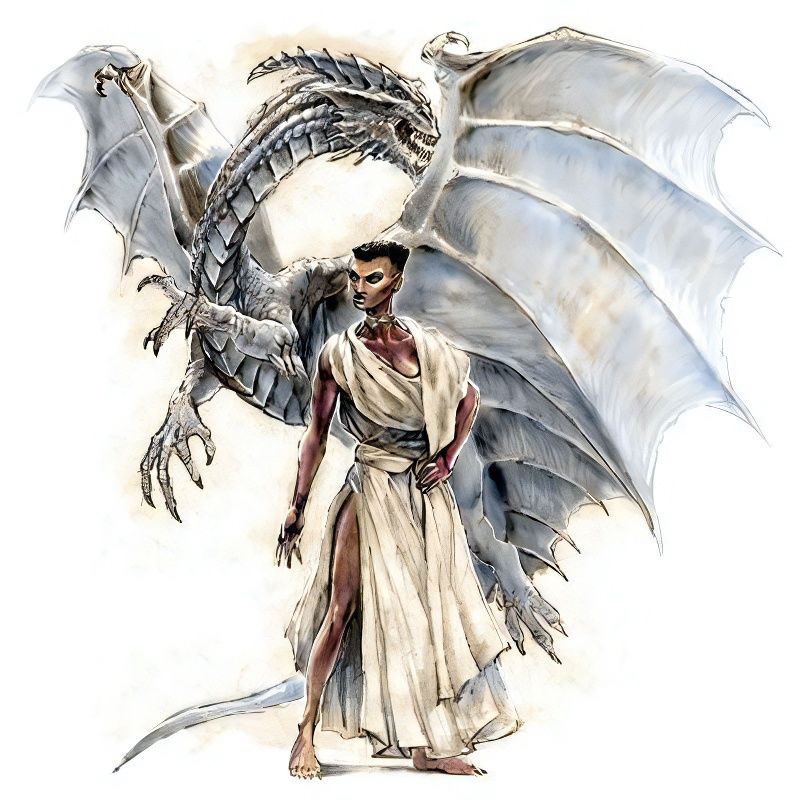
Showing posts with label Dragons. Show all posts

Thursday, March 14, 2013

Another Primordial Dragon

It's been a bit of work to actually finish this bad boy. Odd, since this is one of my favorite dragons of all time. It's the Pit Bull of dragon kind. I actually kind of see this as the Kenpachi Zaraki of all dragons. If I was to ever play in a Council of Wyrms game, I think this is the dragon breed I'd want to play. 

Fang Dragon


Poised to pounce, this steel gray dragon is a mass of claws, blade-like scales, and fangs. Even down to the end of it's bladed tail, this dragon looks as though it was born to rend and tear. Despite the shorter wings, you are very sure that you cannot run fast enough or far enough to evade it's leap.  

CN dragon
-------------------------------
Base Statistics
-------------------------------
CR 2; Size Tiny; Hit Dice 3d12
Speed 60 ft.
Natural Armor +2; Breath Weapon Bite*, 1d2 Constitution drain
Str 12, Dex 18, Con 13, Int 7, Wis 13, Cha 7

Ecology
Environment Temperate Mountains
Organization solitary or mated pair
Treasure triple

-------------------------------
Special Abilities
-------------------------------

Breath Weapon (Su): A fang dragon does not have a "breath weapon", per say. Instead, it's bite drains the Constitution of those unfortunate enough to have been bitten by the dragon. When a fang dragon bites a target, that target must make a Fortitude save against a DC equal to what the fang dragon's breath weapon DC. A failed save takes the full Constitution damage, and a save indicates that the target only take half the Constitution damage. If the target does not have a Constitution score, the target instead takes double the amount of damage rolled as hit point damage.

Increased Damage (Ex): A fang dragon's physical weapons are always considered those of one age category higher.

Rend Magic (Su): When a Young Adult or older fang dragon hits with both claw attacks on the same target, that target takes an additional 1d6 points of damage. Also, the target is subjected to a targets dispell magic, as per the spell. The caster level for the targeted dispell is equal to the dragon's hit dice.

Sound Imitation (Ex): A very young or older fang dragon can mimic any voice or sound it has heard by making a successful Bluff check against a listener's Sense Motive check.

Spell Like Abilities (Sp): Fang Dragons gain a number of "anti-magic" spell-like abilities. Very Young - detect magic, read magic; Young - shield; Adult - spell turning; Old - telekinesis; Great Wyrm -  globe of invulnerability (can only be cast once every 1d4 hours). 


Age Category


Special Abilities


Caster Level


Wyrmling

 Increased Damage, Short Wings, Trip
---


Very Young


Sound Imitation, Detect Magic, Read Magic


---


Young

Pounce, Shield
---


Juvenile


DR 5/Magic, Spell Resistance


---


Young Adult

Frightful Presence, Rend Magic
1st


Adult

 Spell turning
3rd


Mature Adult

 DR 10/Magic
5th


Old

 Telekinesis
7th


Very Old

 DR 15/Magic
9th


Ancient


Fast Healing 2


11th


Wyrm

 DR 20/Magic
13th


Great Wyrm

 Globe of Invulnerability
15th

Fang dragons are apex predators, especially when it comes to creatures that rely heavily on magic for defense. Known to hunt through wooded foothills and mountain valleys, even other true dragons take pause before confronting a fang dragon. They are, as a whole, revel in engaging in physical conflict. They will sometimes attack foes more to test themselves than to actually kill and eat a foe.

Of all dragons, these are the most solitary, but also the most likely to work with another being that has physically beaten it. This can sometimes lead to an odd friendship, but mostly it is put in place to allow the dragon to constantly test itself against the one that defeated it. This can cause some very discomforting situations, depending on how the dragon and it's "conqueror's" attitudes match.


The Primordial Dragons

I am apparently on a draconic roll. I really like the various dragons created over the years. There are a number of dragons that were created in the Forgotten Realms books, Dragon Magazines, and a few other sources. Some have translated over into Pathfinder, and some, I have started translating into Pathfinder. I find trying to update the Dragons that I find to be a somewhat cathartic experience. I can't guarantee that I'll even use half of these dragons, but I at least know that they're there if I need'em. Also, it helps get some of my mildly creative juices going.

The Primordial Dragons


While not a true "type" of dragon; like the arcane, chromatic, or metallic; Primoridal Dragons are a general classification among some sages for those dragons that meet the following "requirements" :

  1. A True Dragon

  2. Not easily classified into another category (ie. not a dragon "known" for it's colorization or other trait)

  3. Have a more "primal" or "primitive" appearance (such as smaller or no wings, weaker spell casting ability)

  4. Found in very selective locations or in lower numbers than other dragons.

While these "requirements" are not hard rules by any means, the designation of "primordial" places the dragon in a rather interesting place for those that study the true dragons of the world.

It has been proposed that this dragons are forebears to the current dragon races. They are to the other dragons what some consider orcs and neanderthals to humans and elves. This proposition is not one that is ever addressed in the presence of any dragon, as the very notions seem to cause even the most tolerant of dragons to lash out the one who made the "derisive statement". Most such thoughts are wisely kept to the quiet musing and pondering of sages,  written in tomes that are best tucked safely away for draconic eyes.

It is interesting to note, though, that while a number of the "primordial" dragons have a limited spell casting ability, many are specialized in natural traits that make them masterful counters against the arcane arts. The Fang Dragon and Rattelyr Dragon's spell turning abilities are but one example of this natural adaptation. One cannot but wonder if these are dragons that aren't the primitive forebears, but an actual newer group of dragon breeds meant to counter the increasing magic found more and more among the "lesser" races.

Rattelyr Dragon

This wingless dragon, it's mahogany colored scales shimmering in the heat of the day, raises it's hood as you approach. The dragon's tail begins to twitch and what starts as a low rattle becomes a cacophony of terror in your head and chest, as your heart races to match the frantic sound. 


LE dragon (fire)
-------------------------------
Base Statistics
-------------------------------
CR 2; Size Tiny; Hit Dice 2d12
Speed 60 ft., burrow 30 ft.
Natural Armor +2; Breath Weapon Cone, 1d6 fire
Str 11, Dex 17, Con 12, Int 10, Wis 11, Cha 8

Ecology
Environment Hilly or rocky desert
Organization solitary or rampage (2-4 dragons)
Treasure triple
-------------------------------
Special Abilities
-------------------------------

Hood Extension (Su): A rattelyr dragon can extend it's hood as a free action. Beginning at adult, an extended hood acts as spell turning, able to turn a number of spell levels equal to the dragon's HD, per day.

Rattle (Su): A rattelyr dragon can employ the rattle on it's tail as a standard action. Any nondragon within 240 feet of the rattelyrmust make a Will save (DC 10 + 1/2 the dragon's HD + the dragon's Cha modifier to a minimum of 0). Those that fail are panicked for 4d6 rounds. Those creatures with 5 or more HD are instead shaken for 4d6 rounds. If a creature saves against the rattle it cannot be affected by the same rattle for one day. Spell casters within the range of the rattle must make a Concentration check (DC 10 + 1/2 the dragon's HD + the dragon's Cha modifier to a minimum of 0) in order to cast any spell or employ any spell-like ability. This is a sonic, mind-affecting ability.

Rattle, Improved (Su): In addition to the affects of the rattle, an Old rattelyr dragon can also induce vertigo in those affected by the rattle. In addition to the Will save, those in range for the rattle must also make a Fortitude save at the same DC, or become sickened for 4d6 rounds.  If a creature saves against the rattle it cannot be affected by the same rattle for one day. This is a sonic, mind-affecting ability.

Tremorsense (Ex): A very young rattelyr dragon gains tremorsense out to 60 feet.

Resistance to Electricity (Ex): Starting as a wyrmling, the dragon develops a resistance to electricity that increases over time, until it reaches it maximum as a Mature Adult.

Rapid Strike (Su): A very young rattelyr begins to show the quick and brutal moves that the breed is well known for. A rattelyr has a +4 bonus on Initiative checks. This ability does stack with Improved Initiative, should the dragon take that feat. Additionally, if a rattelyr dragon goes first in the round, at the end of the round the rattelyr dragon can either make a single melee attack at a -5 penalty or move half it's speed.

Spell Like Abilities (Sp): Rattelyr dragons, unlike most other dragons, only gain one spell-like ability. This ability is still usable at will. Great Wyrm - scouring winds.

Viscous Breath (Su): An ancient rattelyr has learned to make the most of it's breath weapon. Instead of just breathing flame, it will mix the breath with sand and dirt, creating a thick, sticky, crude blast of molten glass. The first time an ancient uses it's breath weapon in combat the breath weapon is this vicious viscous conflagration. Those that do not save against the breath weapon continue to take damage for a number of rounds equal to the dice of the breath (thus if the breath weapon does 6d6 of damage, it would last for 6 rounds). Each round the damage done by the viscous breath is one die less as the breath begins to cool, until it finally hits 0d6. The additional damage can be avoided by either taking a round to remove the heated goop, or using a cold or water based spell on the victim (many a life has been saved by a well timed create water spell).


Age Category


Special Abilities


Caster Level


Wyrmling

Resistance to Electricity 5, Rattle
---


Very Young


Rapid Strike, Tremorsense


---


Young

Frightful Presence, Resistance to Electricity 10
---


Juvenile


DR 5/Magic


---


Young Adult

Resistance to Electricity 15, Spell Resistance
---


Adult

Hood Extension
1st


Mature Adult


DR 10/Magic, Resistance to Electricity 20


3rd


Old

Improved Rattle
5th


Very Old

DR 15/Magic
7th


Ancient


Viscous Breath


9th


Wyrm

DR 20/Magic
11th


Great Wyrm


Scouring Winds


13th

Found in remote "badland" environments, filled with rocky outcroppings, sparse vegetation, and many stony canyons and vales, rattelyr dragons are a hardy breed of dragons, rarely found near the settlements of other beings. Very territorial, and somewhat xenophobic, rattelyr dragons prefer their solitude. Yet, despite this, they are also a curious lot, and will often question helpless victims about the latest gossip and news while the unfortunate soul slowly bakes in the heat of the day.

While not the most social of dragons, rattelyrs are not fools. They will negotiate agreements with others if that agreement is beneficial to the dragon. Evil wizards, fleeing warlords, and others that may find a "badlands" area as a perfect place to establish a power base would do well to curry the favor of a local rattelyr. The easiest way to do this is to slay a blue dragon. Blue dragons are the greatest rivals of rattelyrs, and the two often attack the other first and never get to asking questions.

Rattelyr dragon's scales start of a reddish mahogany color, darkening to a black, almost charcoal, as it grows older. The hood also  grows more elaborate as the dragon ages. No two hoods are the same, each with ornate gray-white markings on the back. Some hoods maintain a smooth curved appearance, while others present a more ribbed, almost spiny hood. Among rattelyr's, one's hood is a matter of pride, and it is not unusual for an older rattelyr's impressive hood to also be adorned with rings and babbles. It is also not unheard of for rattelyrs to stop and converse with any creature with a hood or similar mantel. One confirmed report indicated that a dragon actually spent a number of hours speaking with a cobra caste Nagah regarding the proper maintenance and care of one's hood.


Wednesday, March 13, 2013

Return of the Arcane Dragons IV

Again, yes, (Greyhawk) Steel Dragons are not technically Arcane. I kind of see them as a stepping point between your standard metallic and the arcane branch of the dragon family. I've seen another "pathfindered" steel, and I don't really think the other version that I saw really fit what I felt was the intent behind the original creature. Of course, I suspect that the version I saw was a conversion of the 4E version of the steel.  As usual, this is not meant to be a challenge of copyright, or any of that nonsense. I decided, like with the song dragon, to diverge a little from the pre-created dragons, and instead of doing a straight one-for-one conversion, I went to make a true "urban" dragon. Something that can serve as an impressive NPC in almost any type of game. This is just a fan created modification of a dragon offered to other fans as a possible addition to a game. 

Steel Dragon

A large metallic blue-gray dragon, watches you with appraising steel-gray eyes. 

NG dragon (arcane, metal, metallic)
--------------------------------------------------
Base Statistics
--------------------------------------------------
CR 3; Size Small; Hit Dice 4d12
Speed 30 ft.
Natural Armor +1; Breath Weapon Cone, 1d6 corrosive steam (half fire, half acid)
Str 9, Dex 14, Con 11, Int 15, Wis 14, Cha 17

Ecology
Environment Any
Organization solitary or family (2-4 dragons)
Treasure triple
--------------------------------------------------
Special Abilities
--------------------------------------------------

Dragonwrought Smithing (Ex): Due to a steel dragon's innate understanding of metals, a steel dragon has a +5 racial bonus to all Appraise and Craft checks when dealing with metals and metal objects.

Know the Streets (Su): While in an urban environment, a steel dragon can maneuver, both physically and socially, like few other creatures. The steel dragon gains a bonus equal to half the dragon's HD to Bluff, Diplomacy, Knowledge (Local), Perception, Sense Motive, and Stealth checks.

Moderate Arcane Shield (Su): A young adult shield dragon gains a +10 bonus to it's Spell Resistance against spells of 4th level or lower.

Poison Resistance (Ex): Very Young steel dragons gain a +10 resistance to poisons and toxins.

Speak with the City's Spirit (Su): Once per day, a wyrm steel dragon can speak with the collective essence of the city that they call home. This acts as a commune spell equal to the dragon's caster level.

Spell-Like Abilities (Sp): Steel dragons gain a number of spell-like abilities as they age. The abilities are usable at will upon reaching the listed age category. Wyrmling - heat metal; Young - charm person; Mature Adult - detect thoughts; Very Old - mass suggestion; Great Wyrm - mass charm.

Steel Immunities (Ex): Beginning at adult, a steel dragon gains resistances to both fire and acid. These resistances are equal to 10 + the dragon's Hit Dice + Constitution modifier.

Without a Trace (Su): Old steel dragons are so at home in their chosen homes that they can vanish in a crowd, or disappear into a shadowy alley, with almost know way of knowing where they went. This acts as the druid's woodland stride and trackless step class features. Also, at will the dragon can shadow jump as a 10th level Shadow Dancer. These are only usable in an "urban" environment.


Age Category


Special Abilities


Caster Level*


Wyrmling

 Dragonwrought Smithing, Heat Metal
---


Very Young


Spell Resistance, Poison Resistance


1st


Young

 Charm Person, Know the Streets
3rd


Juvenile


 DR 5/magic, Frightful Presence


5th


Young Adult

 Moderate Arcane Shield, Suggestion
7th


Adult

 Steel Immunities
9th


Mature Adult


 DR 10/magic, Detect Thoughts


11th


Old

Without a Trace
13th


Very Old

Mass Suggestion
15th


Ancient


DR 15/magic


17th


Wyrm

 Speak with the City's Spirit
19th


Great Wyrm


DR 20/magic, Mass Charm


21st**

*Steel dragons add the spells from the Artifice and Community domain as bonus spells to their spells known.
**Grants no more spells know per day than a 20th level sorcerer, but improves spell effects depending on caster level.

When elves built their first mythrals, they were there. When the giants formed great monument cities, they were there. Steel dragons have been around for as long as sentient beings have decided to gather together for mutual benefit, possibly even directing such gatherings from the shadows. They are normally upstanding citizens in whatever city they decide to lair in, with most of the populace not even aware that a dragon lives among them. Master craftsman from birth, steel dragons love to build not just babbles, weapons, and implements, but communities and neighborhoods. A section of town where a steel dragon has taken residence normally sees an increase in prosperity and a decrease in crime, without any outward sign for the sudden upturn. Steel dragons are so much a part of the communities that they reside in that they are often referred to by the metropolis of the area as their dragon type.

It is often said that the steel dragons are the results of tome and some metallic dragons sharing space too close to an early urban area. Steel dragons seem to share traits from both arcane and metallic dragons. As such, the reactions from other dragons can be very mixed. Most arcane dragons consider them honored cousins, except for the hex dragons who think they tie themselves to much to sophistry, kowtowing   and other "lesser" trappings. Metallics often see them as odd relatives, with most just preferring to keep their distance, but remain polite enough. Chromatic dragons, and most other types of dragons, commonly see steel dragons as barely dragon at all, more akin to the weak lesser beings that they prefer to keep their time with than a true dragon.

Return of the Arcane Dragons


While working on a new setting, I was called to remembrance of the Arcane Dragons. They were in the Creature Catalog V, published in Dragon Magazine #343, and written by Jake Manely. These were an interested group of true dragons, currently consisting of only two breeds, the Hex and the Tome. I wanted to update them for Pathfinder. In looking over the dragons, and the Advance Player's Guide, I see these dragons as having some very interesting potential.  After looking again and again on the internet, I did not find anyone else having posted or presented an updated versions of these dragons, so I figure I will. Now, there are going to be some alteration to some of the dragons in these posts from the original. These are meant to catch the flavor of the dragon, as well as present some new options. I want to keep with the theme of the dragon, and open the arcane dragons as a more specialized casters. I'm, as always, not trying to step on any toes, or infringe on any copyrights or anything like this. These are all little bits of Fan Love, presented to the general public as little bits to add to their own games.

Dragons, Arcane


Arcane Dragons are tied more closely to the inherent magic that courses through all draconic veins. As such, while they are physically weaker and more fragile then their chromatic or metallic brethren, they are master of magics known to few others. Also, due to their high arcane abilities, but weaker physical capability, arcane dragons often spend almost as much time in and around humanoids, residing in ruins, monasteries, and, in some cases, even cities. They can serve as advisers, instructors, and patrons. Rarely does an arcane dragon take a real leadership roll. Even rarer is the knowledge that the sage, scholar, sorcerer or wandering stranger was anything more than a typical member of the society. This secrecy is due to the number of beings out there that would attempt to enslave or otherwise misuse the dragon.

Combat


Most Arcane Dragons, even in their older years, are not the titanic powerhouses their cousins are. In combat an arcane dragon will prefer to send minions in first, if possible, and whittle away at their foes with breath weapon and spell. Preferably, though, an arcane dragon will never get into the position that they have to engage in combat, instead manipulating and affecting things from the shadows. Most arcane dragons actually feel the notion of dirtying their claws is a sign that something failed terribly. Arcane Dragons have many of the same options as a standard true dragon, with the following additional traits.

Alternate Form (Su): An arcane dragon can assume another form 3 times per day as a standard action. All arcane dragons can assume the form of any humanoid creature or animal of Medium size or smaller.

Graceful Flyer (Ex): A young or older arcane dragon's aerial maneuverability is one step better than normal.

Physical Frailty (Ex): Arcane dragons have smaller limbs and weaker natural weapons than other dragon breeds, and are far less suited for physical combat. When determining the type and damage dealt bu their natural weapons, treat arcane dragons as if the dragon is  one size category smaller than they actually are (minimum of Tiny), and subtract the reach of all claw and wing attacks by 5 feet.

Hex Dragon


The dragon's scales ripple with eldritch might, with faint glowing runes pulsing in time. Deep purple in color, the dragon's horns corkscrew above a pair of cunning emerald eyes.

NE dragon (arcane, earth)
-------------------------------
Base Statistics
-----------------------------------------------
CR 3; Size Small; Hit Dice 4d12
Speed 30 ft., burrow 20 ft., swim 30 ft.
Natural Armor +2; Breath Weapon line, venom (see below)
Str 9, Dex 18, Con 11, Int 13, Wis 12, Cha 15

Ecology
Environment Any forest, marsh, or underground
Organization solitary or coven (1-3 dragons)
Treasure triple
-------------------------------------------------------------
Special Abilities
-------------------------------------------------------------
Breath Weapon (Su): A hex dragon has one breath weapon, a line of venom. The following is the effects of the venom:
Putrid Venom breath weapon
Type Poison, Contact; Save Fortitude DC (constitution based.)
Frequency 1/round for 4 rounds.
Effect Con damage equal to 1/2 the dragons age catagory
Hex (Su): A hex dragon gains the ability to cast hexes, as a witch. At each age category a hex dragon can select another hex, from the hexes available to a witch. When a dragon reaches Adult it can begin to select hexes from the Major Hex list. Beginning with Ancient, a hex dragon can choose a Grand Hex.

Unless otherwise noted, using a hex is a standard action that does not provoke an attack of opportunity. The save to resist a hex is equal to 10 + 1/2 the dragon's HD + the dragon’s Charisma modifier.

Patron (Su): A very young hex dragon can choose to become a witch's patron. The patron's theme for the witch are the same as the themes of the hex dragon know to the hex dragon at that time. Upon reaching Old, the hex dragon can expand the benefits of belonging to a coven to a number of other individuals equal to the dragon's Charisma modifier. The dragon counts as a hag for the purposes of creating a coven.

Retributive Curse (Su): Hex dragons have learned to channel their pain and anger into terrible retributive magic; many foes who succeed in wounding a hex dragon find themselves wishing they could take back the blow. On any round in which a hex dragon is injured (takes hit point or ability damage), the dragon may curse one of the opponents who injured it as a free action. The effects of this curse increase as the dragon ages:
Sickness: The target is sickened for 1d4 rounds.
Agony: The target is crippled by agonizing pain (treat as nauseated) for 1d4 rounds.
Blindness: The target is permanently blinded.
Insanity: Target becomes permanently confused, as per the spell insanity.
Oblivion: Target is obliterated (as if affected by a sphere of annihilation).
A successful Will save negates the effect. A hex dragon may bestow curses from younger age categories, if it so chooses. The save DC against the curse is 10+1/2 the dragon's HD + the dragons Charisma modifier.

Should a hex dragon ever be killed or mortally wounded (reduced to negative hit points), it reflectively unleashes a death curse against all creatures withing a radius equal to 10 feet per age category. All creatures within the area must save as above or suffer the affects of the highest level of curse available to the dragon.

Spells (Sp): A hex dragons cast spells as a sorcerer of it's appropriate caster level. It selects its spells, though, from the witch's spell list. A hex dragon also selects a Patron theme starting as at Very Young, and then one additional Patron theme for every other age category. The bonus spells from the theme are automatically known as the dragon progresses in age.

Vile Resistances (Ex): A hex dragon receive a +4 bonus on saves versus death effects, enchantment spells, and spells and effects that deal negative energy damage. They are immune to disease and poison.


Age Category


Special Abilities


Caster Level*


Wyrmling


Hex, Retributive Curse (sickness), Vile Resistances


---


Very Young


Hex, Patron, Patron theme


1st


Young


Hex, Retributive Curse (agony), spell resistance


3rd


Juvenile


Hex, DR 5/magic


5th


Young Adult


Hex, Frightful Presence


7th


Adult


Hex, Retributive Curse (blindness)


9th


Mature Adult


Major Hex, DR 10/magic


11th


Old


Hex, Expand Patron


13th


Very Old


Hex, Retributive Curse (insanity)


15th


Ancient


Grand Hex, DR 15/magic


17th


Wyrm


Hex


19th


Great Wyrm


Hex, Retributive Curse (oblivion)


21st**

*See Spells above.

**Grants no more spells know per day than a 20th level sorcerer, but improves spell effects depending on caster level.

Cunning manipulators, hex dragons prefer to reside in swamps, marshes and forests, not too far away from a settlement of creatures that it can bring under it's thrall. Hex dragons prefer to work through henchmen and agents, using it's hexes, spells, and other talents to manipulate, cajole, intimidate, and otherwise insinuate itself behind a mask of patsies and minions into an area. The less they have to do themselves, the better. Do not take this for laziness. A hex dragon can be very industrious should the need arise.

There is a common misconception that there are only female hex dragons. While the number of female hex dragons do out number males by three to one, the male of the species do exist. It is not unheard of, though, for a female hex dragon to breed with another dragon breed, if they can find a willing possible mate, or trick a potential mate.

A hex dragon's greatest threat, though, is not heroes. Other dragons that may share it's territory are the truest threat to a hex dragon. Black dragons are known to find hex dragons and their eggs to be a delicacy. Green dragons, on the other hand, are fond of selling stolen hex dragon eggs to foolish "lesser beings", enjoying the treasure the sale has brought, and the chaos soon to be wrought. It is not unheard of for a noble family to have a "pet dragon" in it's household, not realizing that it's the dragon that is turning the family into it's pets. Such arrangements do not often end well for the nobles.

Return of the Arcane Dragons III

I know that the original song dragons, from the Forgotten Realms, was not considered an Arcane Dragon. I also know that it wasn't a water dragon. I wanted, though, to recreate it in a more "appropriate" aspect though. The wandering dragon bard made a lot more sense to me then the more martial dragon type originally presented. This is actually pretty much a completely new dragon, that shares really only the name with it's predecessor, and possibly the art, since I haven't found anything else that fits.  As usual, this is not meant to be a challenge of copyright, or any of that nonsense. This is just a fan created modification of a dragon offered to other fans as a possible addition to a game. 

Song Dragon

With rippling silver-blue scales and an expressive face, this slender and elegant dragon's voice is like a running mountain stream. The scent of a midsummer rain storm hangs in the air, adding to the feelings of anticipation the dragon seems to inspire. 

NG dragon (water, arcane)
-----------------------------------------------
Base Statistics
-----------------------------------------------
CR 3; Size Tiny; Hit Dice 3d12
Speed 30 ft.
Natural Armor +1; Breath Weapon Cone, 2d4 sonic
Str 9, Dex 14, Con 11, Int 15, Wis 14, Cha 17

Ecology
Environment Any
Organization solitary or troop (1-6 tome dragons)
Treasure triple
-------------------------------------------------------------
Special Abilities
-------------------------------------------------------------

Draconic Knowledge (Ex): Song dragons, much like bards, are walking libraries of stories, myths, legends, songs, poems and parables. While bards must study for this information, it is ingrained in a song dragon from birth. A song dragon adds half her hit dice (minimum 1) to all Knowledge skill checks and may make all Knowledge skill checks untrained.

Draconic Performance (Su): Natural performers, story tellers and minstrels, young song dragons are able to use bardic performances as if they were bards of the same level as their caster level. They use the same rules for Bardic Performance, replacing their caster level when determining prerequisites. A song dragon can use her draconic performance a number of rounds per day equal to 4 + her Charisma modifier + her Hit Dice.

Summon Lillend (Sp): Old song dragons can call a lillend forth from Elysium to serve as either accompaniment or an ally in battle. This ability works like a summon monster spell, except that it only summons a lillend. This is equivalent of a 6th level spell.

Spell-Like Abilities (Su): Song dragons gain a number of spell-like abilities as they age that are useful in their travels. The abilities are usable at will upon reaching the listed age category. Very Young - charm person; Young Adult - hydraulic push; Mature Adult - detect thoughts; Very Old - control water; Wyrm - elemental body III (air, electricity, ice, or water); Great Wyrm - weather control.

Truespeech (Su): Adult song dragons have learned the secrets of languages, surpassing even the best linguist. Song dragons can speak with any creature that has a language, as though using the tongues spell (equal to the dragon's Hit Dice). This ability is always active.

Vertigo's Song Breath (Su): Instead of a cone of sonic energy, a song dragon can breathe a cone of sound the induces vertigo. Creatures caught in the cone must make a Fortitude save or gain the mauseated condition for 1d6 rounds plus 1 per age category of the dragon.


Age Category


Special Abilities


Caster Level*


Wyrmling


Draconic Knowledge, Vertigo's Song Breath


---


Very Young


Charm Person, Water Breathing


---


Young


Draconic Performance, Spell Resistance


1st


Juvenile


 DR 5/magic


3rd


Young Adult


 Hydraulic Push


5th


Adult


 Frightful Presence, Truespeech


7th


Mature Adult


 DR 10/magic, Detect Thoughts


9th


Old


 Summon Lillend


11th


Very Old


 Control Water


13th


Ancient


DR 15/magic


15th


Wyrm


 Elemental Body III


17th


Great Wyrm


 Weather Control


19th

*Song Dragons cast spells and select spells as bards, instead of as sorcerers.

One of the most wide spread of the dragons, song dragons can be found almost anywhere. They prefer travelling from place to place, often secreting themselves into a nomadic tribe, traveling actors troop, or even the occasional adventuring party. They love social interaction, but understand that their draconic nature can be as much a curse as a benefit in this regard. Thus, a song dragon is not open about their nature to most who come in contact with them. Sadly, this does, occasionally mean a surprising birth of a half-dragon a number of months after the minstrel has left town.

Return of the Arcane Dragons II


The second of the Arcane Dragons, this breed is actually my favorite. It's really the reason that I started "updating" this and the Hex Dragon to Pathfinder. I hope that this updated version works for you and your game. 

Tome Dragon

With a mane of white hair framing it's wise face, this dragon's many hued scales reflect light in a shimmering pattern. It's tail ends in a wide fin, not unlike some great fish.

LN dragon (air, arcane)
--------------------------------------------------
Base Statistics
--------------------------------------------------
CR 3; Size Tiny; Hit Dice 3d12
Speed 30 ft.
Natural Armor +1; Breath Weapon blast,1d8 elemental
Str 7, Dex 14, Con 9, Int 16, Wis 14, Cha 15

Ecology
Environment Any mountain or ruin
Organization solitary or cloister (2-6 tome dragons)
Treasure triple
-------------------------------------------------------------
Special Abilities
-------------------------------------------------------------
Breath Weapon (Su): A tome's dragon breath weapon is weak (compared to other dragons), but very adaptable. Tome dragons can accurately spit a small bead of raw elemental material great distances (as far as a dragon's line breath weapon can extend), which then explodes in a manner similar to a fireball (blast radius equals 5 feet per age category). While the amount of damage remains the same no matter which element is used, the type of damage varies: a blast of air deals sonic damage, earth deals piercing damage, water deals non-lethal bludgeoning damage, and fire deals fire damage.

Eldritch Study (Su): Beginning as a wyrmling, a tome dragon takes a subject of magic and focuses on the study and mastery of that aspect. The tome dragon selects a school of magic as if it were a wizard. She gains the benefits of that school with her caster level being used as her wizard level; she also gains the same drawbacks as a specialist wizard and must select two opposing schools. Also, at each increase of caster level, if the dragon has chosen to specialize, she gains a bonus spell known from the selected school.

Free Metamagic (Su): Metamagic comes naturally to tome dragons. Applying a metamagic feat to a spell takes no extra time for a tome dragon (rather than increasing casting time to a full-round action, as normal for a sorcerer). In addition, tome dragons can subtract an amount based on their age category from the increase in spell level caused by using metamagic feats. The number listed is the total reduction in extra spell levels, not the reduction for each feat applied. This bonus can only be applied to one spell per round (additional spells cast in a single round are unaffected).

Insight (Ex): After years of studying a diverse number of topics, a young dragon begins gaining an understanding on how others think, and react. This translates into an insight bonus to AC, CMD, and Will saves equal to half the dragon's Intelligence modifier.

Spell-Like Abilities (Su): Tome dragons gain a number of spell-like abilities as they age that assist them in the gathering of knowledge. The abilities are usable at will upon reaching the listed age category. Wyrmling - arcane sight; Juvenile - clairaudiance/clairvoyance; Mature Adult - plane shift; Ancient - true seeing; Great Wyrm - astral projection.


Age Category


Special Abilities


Caster Level


Wyrmling


Arcane sight, eldritch study, spell resistance


1st


Very Young


Free metamagic: +1 level


3rd


Young


Insight, DR 5/magic


5th


Juvenile


Clairaudiance/clairvoyance


7th


Young Adult


Free metamagic: +2 level


9th


Adult


Frightful presence, DR 10/magic


11th


Mature Adult


Plane shift


13th


Old


Free metamagic: +3 level


15th


Very Old


DR 15/magic


17th


Ancient


True seeing


19th


Wyrm


Free metamagic: +4 level


21st*


Great Wyrm


Astral projection


23rd*

*Grants no more spells know per day than a 20th level sorcerer, but improves spell effects depending on caster level.

The most powerful of draconic spell casters, tome dragons are also one of the weakest of dragons. Where most dragons are known for hording gold, gems, and art, a tome dragon is a gatherer of arcane knowledge. Their hordes are filled with books, scrolls, and crystal balls. While they are not known for aggression or violent behavior, they will defend their libraries and areas of study viciously.  That being said, they understand that throwing their lives away for simple material things is not worth the lost of collected knowledge that they contain.

It is due to this mentality that you will often find tome dragons working and living with others of their kind, or in the employ (sometimes slavery) of powerful beings. In those circumstances they prefer to serve as mentors, instructors, and advisers; roles that their talents shine.

During times that tome dragons gather together, it is often referred to as a "conclave" instead of the more traditional terms of "flight" or "rage". In fact a gathering of such rarely, if ever, has anything to do with "rage". More often a conclave either will gather to discuss important arcane matters, or to make use of a discovered source of knowledge or to construct such a source. Though rare, there have been known instances where some academies of magic, universities and important centers of learning are a long term conclave that never disbanded. It is interesting to note that such gathers rarely have tome dragons that have specialized in the same paths of magic. In a conclave with an "Evocationist", it would be rare to also have an "Admixturist", but not unheard of. In the same example, though, you would not see a second Admixturist or "pure" Evocationist, unless it was a pupil of one of the older dragons.

As a side note, learning and magic are not the only things tome dragons are known for. They have, as a whole, a deep love of tea. While each dragon has slightly differing views on what makes a good tea, anyone that can present a proper tea, especially a rare or exotic blend, will earn the dragons favor. One can make suppositions on the type of tea the dragon will prefer if one knows what type of school of magic they have chosen to focus on. Evocationists enjoy flavorful, spiced teas, Illusionists will oft prefer ones that include heady smells and unique or new flavor combinations, while an Earth elementally focused dragon will be drawn towards earthy, root based teas.

A tome dragon's focus also seems to directly relate to their outlook. A divinationist will look at the bigger picture, an evocationist will be bombastic, a dragon that focuses on Air may be flighty and easily distracted, and a necromancer will be often be morose and dour.