Tuesday, April 02, 2013

Dancing Wasps (The Elven Warrior Houses, part 4)

While this group was never an original "House" created by my friend, the idea of an "Elven Duelist" house has actually been in a number of my games for quite some time. I figure I would include them here. I find that Duelist based games are an interesting sub-section of the standard gaming set up. Not normally meant for a standard group, these type of games are a bit heavier on a single combat per session. While a normal RPG session may have three or four combats that occur, I have found that a duelist game may have one combat between two duelist that may take up the entire session. Maybe I'm not running it as effectively as I could be; and the Ultimate Combat book wouldn't be out for a number of years; but these games are high on the drama, high on the intrigue, and then heavy on the one duel. LOL I may actually put forth some more Duelist styles and such at a later date. There's an old WotC duelist write up. I wonder if I could find that sometime and do a Pathfinder update on it? Hmm... 

Originally, I was going to call this the Dancing Serpents. For some reason, though, it just wasn't really fitting well with me. Then, while I was in the middle of other things, it kind of hit me. Serpents really don't properly represent the sudden, fluttering movements that I envisioned with this House. While a snake strikes, I need something that strikes and then strikes again, just as suddenly and quickly as the the first strike. In Pathfinder, the elves are also tied to a wasp goddess, so this added to where I wanted to go with this House.  I then pondered Drow for a moment, and realized how many wasp vs. spider nature segments I had seen on TV. Things evolved from there. 

Dancing Wasps (Salkal Calar)

Favored Weapons: Dancing Wasps prefer "elegant" blades, such as the dagger, longsword, rapier, scimitar, short sword and similar weapons.

With only the Striking Crane coming close in outward shows of skill, the Dancing Wasps are the House most commonly thought of when one thinks of an "elven duelist". Masters of sudden darting strikes, graceful dodges, and arcane talent, the Dancing Wasps are (in their opinion) the pinnacle of the duelist art form. Of course, there are many differing opinions on that assertion but generations of perfecting a blending of blade and magic have created an unquestionably impressive and deadly style.

Pulling from a large pool of young, eager, glory-hunting nobles, all eager to demonstrate the elvish ideals of perfection in swordcraft and spellcraft, the ranks of the Dancing Wasps are filled with recruits ready to defend the honor of the "elven nation" at the merest provocation. This has given the House a deserved reputation of hotheads and braggarts. Fortunately, though, as an elf progresses within the House, their fevered zeal cool while their skills improve. Heads of houses are often observant, cunning, calculating, and among the most feared duelist of the region, city, or realm.

The darting, quick moving, and never stopping style of the Dancing Wasps is amazing to watch and difficult to defend against. If one masters this difficult style, they can easily gain a reputation and personal wealth as duelist for hire. Such mercenaries traditionally only accept employment of an elven noble house, but there have been those less scrupulous members have accepted employment in any "noble" cause willing to pay.

Many Houses have special distinctions and badges of honor, few, though, have the reputation of those that receive the title of Spider-Slayer Wasp. This distinction is given only to a member of the order that has personally slain a drow in single combat. It is a very coveted award, and those that have received this commendation are seen with awe and admiration among the younger elves. It is important to note, though, that all that needs done is to kill a drow, it does not matter the reason why or what condition the drow is in before the fight begins. It just has to be a "one on one fight". This has caused whispered concern that some Spider-Slayer Wasps are nothing more than bullies and cowards. The general belief of the elves, though, is that a dead drow is still a dead drow, and thus the only good type of drow. (There have been some unsubstantiated rumors that a collective of drow have started to become "Wasp-Hunting Spiders", but other than whispers and a few missing duelist nothing have been confirmed.)

Traditional Colors: Each duelist has their own unique style and sense of fashion, but most will include gold and black, frequently in a wasp motif to signify their allegiance to the House.

Associated Classes: Bards, Magus and multi-classed wizards and sorcerers with levels in fighter, swashbuckler, or rogue are the most common members of the House. There have been reports of a coven of multi-classed witches have started training in the House, as well.

Trait: Stance of the Wasp's Sting (Elf, Combat) - When wielding one of the favored weapons of the Dancing Wasps, the duelist gains a +1 to his combat performance, concentration and Acrobatic skill checks.

Roaring Bear (The Elven Warrior Houses, part 3)

Friends make some odd choices at times. Not necessarily bad choices, just odd ones. (They still also make stupid choices sometimes as well, but that's not what the intent of this little diatribe is.) One of the odd choices my friend made was the creation of the Roaring Bear house. Brawling, pro-wrestling elves didn't make a lot of sense to me. It's been kind of difficult to wrap my head around this house. Elves are not known for their brawn. They are known for their tie to nature and the fae, so that's kinda where I decided to go with this one. 

Roaring Bear (Raavea Morko)

Favored Weapons: Bare hands, natural weapons, hand axes, kama, and daggers.

One of the more obscure Warrior Houses, the Roaring Bears are rarely found in great numbers. Traveling alone, or with a single apprentice, Roaring Bears regularly travel from settlement to settlement, helping out the locals against what ever problems the travelers come across upon their arrival. Roaring Bears serve often as temporary advisers, healers, as well as defenders to the community that they decide to rest at, and as such are rarely turned away by a sane ruler. Their reputation is such that they frequently are found in a wide variety of settlements, regardless of the racial majority, promoting understanding and harmony with their elven neighbors and nature in general.

The most esoteric of Warrior Houses, they are more akin to a monk tradition more than a martial house. Roaring Bear training houses are never found inside a city. Instead, they are normally in deep forests, mountain valleys, or as a rest house at some out of the way oasis. Often, the only entry tests needed to join are to arrive at the Training House and prove your worth (which is understandably easier for some than others). Elven heritage has a strong weight on one's "worthy" but even having one-quarter elven blood is sometimes acceptable. Once granted entrance, the applicant begins the decades-long training required to become a Roaring Bear, learning both unarmed combat as well as the druidic abilities that give the order it's name. It is the only house that requires training as a specific classes before allowing an initiate to go out into the world.

Traditional Colors: Most Roaring Bears wear dark brown with silver and black accents, similar to the colors found on a grizzly bear.

Associated Classes: All Roaring bears have levels in either Druid, often with the Bear Shaman archetype, or Shaman with the Nature Spirit; and levels in Monks or Brawler.

Trait: Necessities of the Bear (Elf, Religious)- A druid member of the Roaring Bears can use monk weapons without violating their vows. A Roaring Bear can level both Monk and Druid without restriction, but only these two classes, and one or the other must be the favored class. Finally, a Roaring Bear is trained to care for themselves and others, they gain a +1 bonus to Heal and Survival checks. One of these skills is always considered a class skill.

Hounds of the Wild Hunt (The Elven Warrior Houses, part 2)

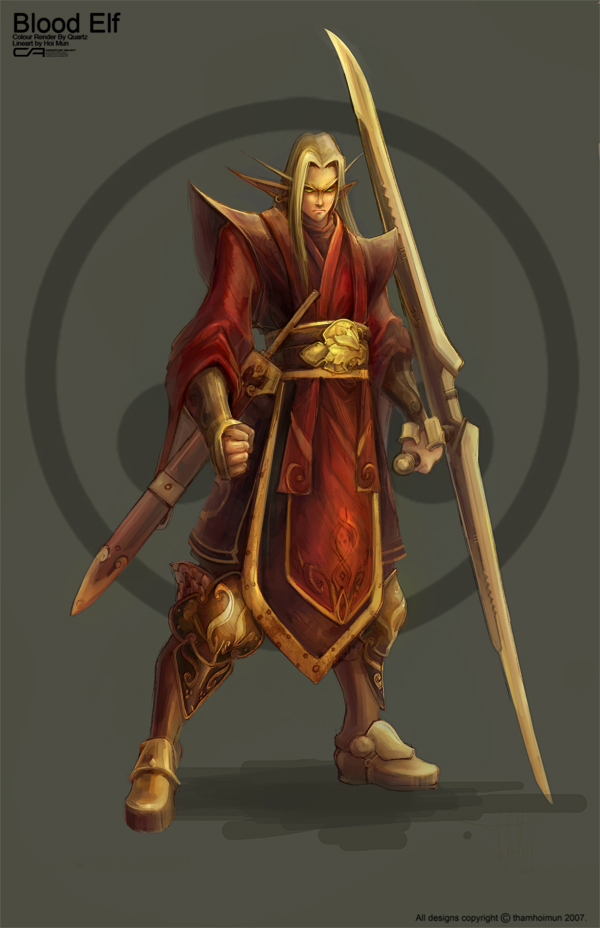
My friend originally called this group "Hellhounds". When I decided to flush out this group, I decided to change the name. The main reason for this was because I don't see elves (except maybe the Blood Elves in WoW) naming any group after anything demonic. I mean, in most fantasy settings, demons and devils have been major thorns in the proverbial elven side.

With that being the case, I decided to look into what my friend was attempting to present in his original concept, and keep with that spirit and theme. The group had "howls" that affected the enemy, they were running dual-wielding swordsmen, and seemed to favor pack tactics. They sounded more like wolves, but there's already a group named after wolves. I then decided to tap into my disturbingly vast mental library of mythology. Since elves have been commonly tied to or associated with Celtic mythology,  I decide to use the Wild Hunt (one of my personal favorite myth references) as the basis for this group. Thus the Hell Hounds have become the Hounds of the Wild Hunt. 

Hounds of the Wild Hunt (Draug i'en' Merka Fera)

Favored Weapons: The Hounds prefer swords that can be wielded effectively in each hand, thus longswords, scimitars, shortswords, and daggers are the preferred weapons of choice.

Often found patrolling the forests and woodlands that serve as the boarders of many elven territories, the Hounds of the Wild Hunt are one of the most commonly encountered Warrior House traditions. They are also the most "down-to-earth" and open minded of the traditions. It is said, with some derision,  that the Hounds will accept anyone into their ranks. While this is not necessarily the case, they will accept any elf, half-elf, and even "elf-friend" (humans, halflings, and gnomes that have been granted elevated status by the leadership of the elves), that proves their mettle to the house. There are even rumors that a small group of "redeemed" drow can be found among their number. This last statement (accusation) has never been confirmed nor proven, and to openly suggest it is considered slander and an open invitation to a duel, if the Hound is being civil, or an out-right attack more oft.

The Hounds of the Wild Hunt are also a practical group that understands that wars are not always won with the massive overt clash of spell and steel. They grasp the value of the sudden surgical strike against supply trains and the removal of important figure heads. It is this willingness to accept these messy facts that contributes to their success, but also turns away most High Elves; causing the other Warrior Houses to consider them to be a "lesser" house. This attitude is very prevalent among the finer members of elven high society, despite the fact that one of the more admired Elf-Queens spent most of her young adult years among the ranks of the Hounds.

While many of the Warrior Houses like to hone the mastery of the individual, the Hounds perfect the "pack" over the whole. It is rare to find a "Hound" operating on her own. This fact is the cause of the common idiom in lands that border elven territories that you never have to worry about the elf that you see, it's the elves that you don't see that will get you.

Traditional Colors: Not ones for the flash and bravado of the other warrior houses, Hounds of the Wild Hunt favor browns and blacks, with the occasional regional camouflage cloak or highlights.

Associated Classes: Without question, barbarians, fighters, hunters, and rangers fill out the bulk of the ranks of this house. One in five Hounds, though, are druids or shaman, often with a focus on the local environs. If it is available, classes with animal companions favor wolves or similar canines.

Trait: Trained in the Hunt (Elf, Combat) - Increase base speed by 5 feet. Additionally, gain a +1 to Knowledge: Local and Survival checks. One of these skills is a class skill for you.